









A Practical Approach to Queue Monitoring, Fitting Room Analytics, and Customer Flow at Scale
Large-format fashion retail presents a unique operational challenge. Stores are often high-traffic, multi-zone environments operating across mixed infrastructure generations, varying layouts, and diverse regional requirements. While customer analytics has become increasingly important for operational optimisation, many retailers face a practical constraint: how to modernise analytics capabilities without replacing large portions of existing CCTV infrastructure or introducing excessive deployment complexity.
This case study outlines a scalable and operationally practical analytics architecture designed for large retail estates, where the objective is not to introduce unnecessary technology layers, but to provide reliable insight into customer movement, fitting room utilisation, and checkout queue conditions using a combination of wide-area sensing, existing CCTV reuse, and centralised analytics.
The Operational Reality of Large Retail Estates
Retail estates developed over many years rarely operate on a single infrastructure standard. Many stores continue to utilise analogue CCTV systems, while newer locations may already incorporate modern IP cameras such as AXIS deployments. Store layouts also vary significantly between regions and formats, creating additional complexity when attempting to standardise analytics across the wider network.
At the same time, operational priorities remain highly consistent:
- Understanding visitor traffic and occupancy
- Monitoring queue conditions during peak periods
- Improving fitting room utilisation
- Maintaining operational visibility across stores
The challenge is not only achieving these outcomes technically, but doing so in a way that remains practical and commercially sustainable at scale.
Traditional analytics deployments often require large numbers of dedicated devices across entrances, queues, and store zones. While effective in isolated deployments, this approach can become increasingly difficult to scale due to:
- Higher hardware requirements
- Additional cabling and installation effort
- Increased maintenance overhead
- Inconsistent deployment approaches between stores
For large retail networks, a more balanced approach is required — one that combines operational value with infrastructure efficiency.
A Practical Analytics Architecture
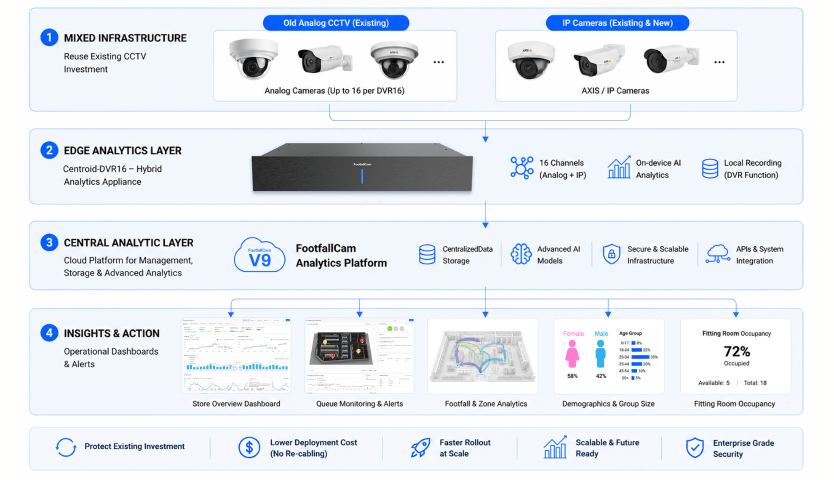
The proposed architecture is designed around three core principles:
- Reuse Existing Infrastructure Where Practical: Existing analogue and IP CCTV cameras remain valuable assets. Where positioning and image quality are suitable, these cameras can continue to support operational analytics without requiring immediate replacement.
- Minimise New Hardware Deployment: Dedicated analytics sensors are introduced selectively in areas where precision is most important, particularly at wide store entrances.
- Centralise Analytics Processing: Rather than deploying multiple independent systems across the store, analytics processing is consolidated through a central platform, simplifying deployment and management.
Hybrid Infrastructure – Analogue and IP Together
A key component of the architecture is the use of hybrid analytics appliances capable of supporting both analogue and IP camera environments simultaneously.
This enables:
- Existing analogue CCTV to remain operational
- AXIS and other IP cameras to be integrated progressively
- Analytics capabilities to be introduced without large-scale recabling
By preserving existing infrastructure, stores can modernise operational analytics incrementally while maintaining flexibility for future upgrades.
In many retail deployments, cabling and installation costs can exceed the hardware cost itself. Avoiding unnecessary recabling therefore represents a significant reduction in overall project cost and deployment disruption.
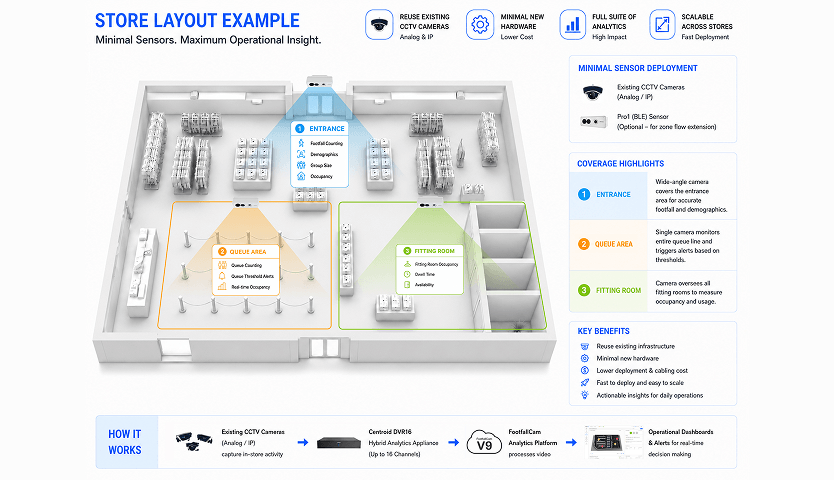
Store Entrances: High Accuracy with Minimal Hardware
Store entrances form the primary measurement layer within the analytics model.
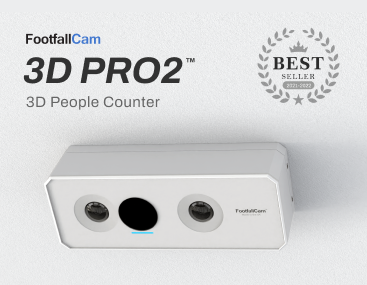
Using wide-angle sensing with top-down coverage, a small number of devices can accurately monitor:
- Visitor counts
- Real-time occupancy
- Demographic trends (where permitted)
- Group size detection
This approach significantly reduces the number of devices required compared to traditional multi-counter deployments.
Rather than placing multiple narrow-field counters across wide entrances, a single wide-area sensor can often provide full coverage when installed at appropriate ceiling heights.
The result is:
- Reduced installation complexity
- Lower hardware count
- More consistent measurement across stores
while maintaining the accuracy required for operational reporting.
Checkout Queue Monitoring: Operational Thresholds Instead of Overengineering
Queue management within large-format retail differs significantly from airport or transport-style queue analytics.
In practice, operations teams are often less concerned with the precise number of people in each queue lane than with understanding whether queue conditions are approaching operational thresholds.
The proposed approach therefore focuses on:
- Queue build-up levels
- Estimated waiting conditions
- Operational threshold alerts
rather than attempting to track every individual within complex queue structures.
Using existing CCTV positioned above structured queue areas, the system analyses customer density and progression across predefined milestone zones.
This enables stores to identify conditions such as:
- Short queues
- Moderate queues
- Extended wait conditions
without requiring extensive additional camera deployment.
The result is a practical and scalable approach aligned with real operational needs.
Fitting Room Analytics: Measuring Demand and Utilisation
Fitting rooms remain one of the most operationally sensitive areas within apparel retail.
Customer demand within fitting room zones directly impacts:
- Staff allocation
- Customer waiting experience
- Overall store conversion opportunities
Using existing cameras positioned at fitting room entrances, the system measures:
- Customer entry and exit
- Occupancy levels
- Utilisation trends over time
The analytics model operates using virtual line-crossing and occupancy estimation, enabling stores to understand usage patterns without introducing additional complexity into changing room areas.
This provides operational teams with visibility into:
- Peak utilisation periods
- Capacity pressure
- Real-time occupancy conditions
while leveraging infrastructure already available within the store.
A Unified Analytics Platform
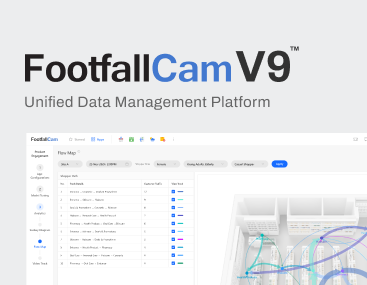
All analytics outputs are consolidated into a unified platform providing visibility across:
- Individual stores
- Regional operations
- Company-wide reporting
The platform supports:
- Dashboard visualisation
- API integration
- Exportable datasets
- Secure role-based access
This enables operational teams to move beyond isolated metrics and develop a consistent understanding of customer activity across the wider retail estate.
Designed for Future Extensibility
While the initial deployment focuses on entrances, queues, and fitting room utilisation, the architecture is designed to support future analytical expansion without requiring replacement of the underlying infrastructure.
Potential future capabilities include:
- Zone Flow Analytics: Understanding customer movement between departments using BLE-assisted flow analysis.
- Product Engagement Analytics: Using Vision Language Models (VLM) to assess customer interaction with products and displays.
- Behavioural Intelligence: Identifying unusual movement or dwell-time patterns that may require operational attention.
Because these capabilities operate on the same centralised platform and shared data layer, they can be introduced progressively as business requirements evolve.
Key Outcomes
The resulting deployment model delivers:
- Reduced hardware footprint
- Lower installation and recabling costs
- Consistent analytics across stores
- Faster rollout scalability
- Operationally relevant insights
- Long-term infrastructure flexibility
Most importantly, it enables retailers to modernise customer analytics in a way that remains commercially practical, operationally focused, and sustainable across large and diverse store estates.
Conclusion
For large-format retail, the success of customer analytics is determined not only by technical capability, but by how effectively those capabilities can be deployed across real-world store environments.
A practical analytics architecture must therefore balance:
- Accuracy
- Scalability
- Infrastructure reuse
- Operational simplicity
- Long-term flexibility
By combining wide-area sensing, hybrid CCTV reuse, and centralised analytics, retailers can achieve meaningful operational insight without unnecessary hardware expansion or disruptive infrastructure replacement.
The result is a deployment model designed not only for today’s operational requirements, but for the long-term evolution of retail analytics across the wider estate.
#OperationalEfficiency #ScalableSolutions #DigitalTransformation #RetailStrategy #SmartStores #EnterpriseTechnology #BusinessIntelligence #AnalyticsPlatform #InfrastructureReuse #FutureOfRetail