


Small Retailer







Supporting Your Existing Investment. Extending Its Value.
People‑counting systems are typically installed for long periods. After five to nine years, most are still running, but the cost structure, capability, and risk profile are no longer optimal.
Contract renewal is usually the only point where organisations are expected to reassess whether continuing with the same system still makes sense. This programme exists to support that reassessment in a structured, transparent way.
Legacy System Replacement Programme
What This Programme Is
This programme is:
- A structured replacement option for ageing people‑counting systems
- Designed specifically for renewal or late‑lifecycle situations
- Focused on cost efficiency, continuity, and practical improvement
This programme is not:
- A general upgrade campaign
- A mandatory replacement
- A discount or clearance programme
- A requirement to adopt advanced analytics
When It Applies
The programme is intended for organisations that meet most of the following:
- Existing people‑counting system installed ≥ 5 years ago
- Contract renewal due or upcoming
- Ongoing service, maintenance, or analytics fees
- Limited ability to improve capability on the current platform
- Internal requirement to demonstrate renewal‑time due diligence
Eligibility is confirmed through a short technical review. Participation does not require commitment.
Renewal Options
The Default Renewal Path
In most cases, renewal results in:
- The same hardware remaining in place
- The same service scope continuing
- Recurring fees rolling forward
This may be acceptable. The programme simply provides an alternative option to review whether replacing ageing hardware would reduce cost or improve capability over the next lifecycle.
What a Pro2 Replacement Includes
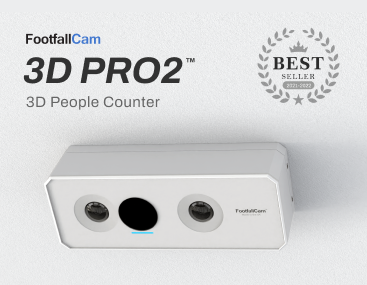
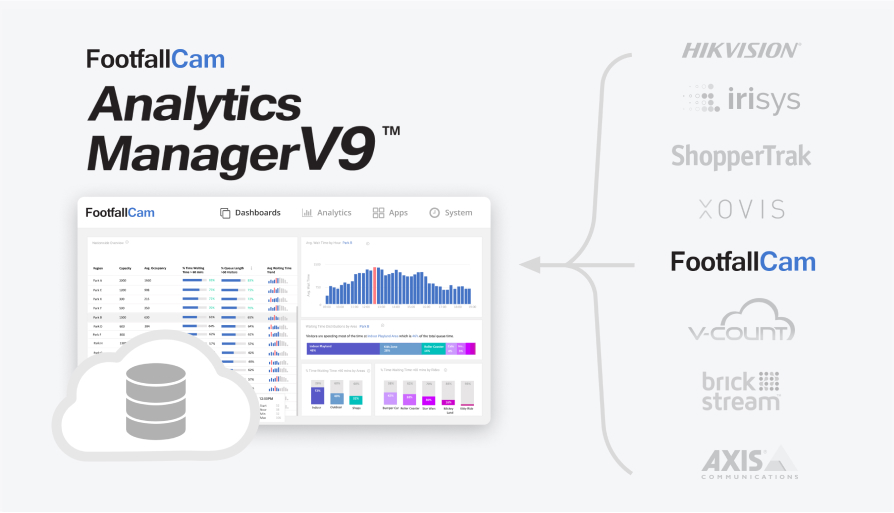
Where replacement proceeds, legacy devices are replaced with the current Pro2 platform.
Included as standard:
- Wide‑angle coverage per device
- High‑accuracy people counting
- Outside and transitional area visibility (where applicable)
- Demographics and group counting
- Staff exclusion (uniform‑based)
- Advanced and predictive analytics capability
- Improved data handling and role‑based access
Retailers can continue using simple in‑out and footfall metrics if that is all they need today. The value is in having a modern foundation that does not need to be replaced again to move forward later.
How it Works
How Replacement Is Carried Out
Replacement is handled as a controlled operational process. Existing cabling and mounting points are reused wherever possible, keeping installation fast and non‑disruptive.
- Suitability review
- Physical swap of devices
- Guided calibration
- Side‑by‑side performance verification
- Acceptance once data quality is confirmed
Replacement only proceeds when performance meets or improves on the existing system.
Validation Before Any Commitment
For eligible cases, the programme includes access to a validation unit. This allows teams to see real performance in their own environment before making a decision.
The validation is limited in scope, time‑bound, and provided with no obligation to proceed. Its purpose is to support proper due diligence, not to push an outcome.
Replacement only proceeds when performance meets or improves on the existing system.
Commercial Options
Different organisations have different financial structures. The programme supports several approaches:
- Outright replacement
- Phased replacement across an estate
- Replacement aligned with contract renewal
- Analytics‑as‑a‑Service for OPEX‑focused teams
Commercial discussions take place after validation, based on confirmed suitability and performance.
Renewal Outcomes
Expected Renewal Outcomes
Retailers using the programme typically achieve one or more of the following:
- Lower long‑term cost compared to renewal
- Wider and more consistent coverage
- Improved trust in footfall data
- Reduced maintenance and support risk
- A modern baseline without operational disruption
Outcomes depend on site conditions and commercial context.
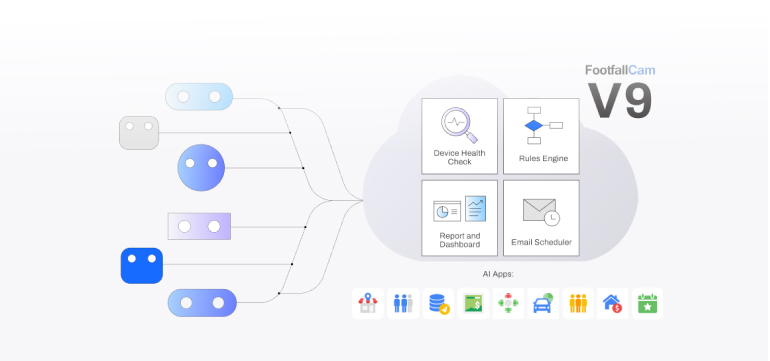
This offer is exclusively for businesses no longer purchasing new devices from other vendors but planning to transition or migrate to FootfallCam’s V9 platform.
Documentation
Programme Documentation
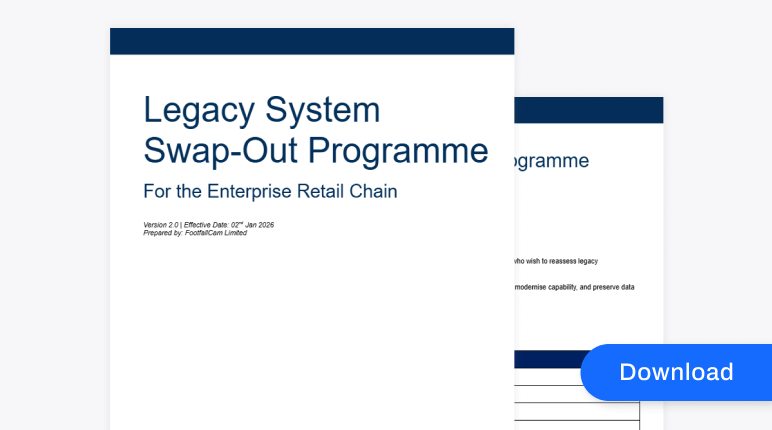
The programme is supported by a concise two‑page overview outlining scope, responsibilities, and validation steps. This is designed for easy internal circulation and review.
Case Study
National Fashion Retailer
Grocery & Convenience Chain
Regional Shopping Centre Operator
Electronics Retailer
International Transport Hub Operator
Home Improvement Retail
Lifestyle & Sporting Goods Retailer
Healthcare Retail
Quick-Service Restaurant
Forecourt & Convenience
Franchise Retail
Multi-Brand Retail
International Airport Retail
National Department Store Chain
National Fashion Retailer
Case Study 1
Contract Renewal Without Added Value
Business: National Fashion Retailer
Type: Apparel & Accessories
Estate Size: ~180 stores
Country: Germany
Situation
The retailer had been operating the same people-counting system for over eight years under a recurring SaaS model. While the system remained operational, renewal discussions revealed that the service scope had not meaningfully changed in several contract cycles. Reporting remained limited to basic in/out counts, with little transparency into data processing or roadmap development.
The vendor continued to charge recurring fees with minimal incremental investment, and internal stakeholders began questioning whether the cost still reflected the value being delivered.
Consideration
At renewal, the retail operations team initiated a formal due-diligence review. The objective was not to disrupt store operations, but to evaluate whether modern alternatives could provide broader coverage, better accuracy, and improved analytics at a lower long-term cost.
The review highlighted that newer platforms could deliver wider coverage per device, include demographics and staff exclusion as standard, and reduce overall maintenance burden without changing existing cabling or store layouts.
Outcome
A staged legacy replacement was approved. Devices were swapped during normal maintenance windows using existing infrastructure. The retailer achieved a measurable reduction in annual operating cost while expanding analytics capability. Most importantly, renewal discussions shifted from price defence to value optimisation, and the new baseline was accepted as more sustainable for the next lifecycle.
Grocery & Convenience Chain
Case Study 2
Introducing Competition to Reset Commercial Terms
Business: Grocery & Convenience Chain
Type: Food Retail
Estate Size: ~420 stores
Country: United Kingdom
Situation
The retailer had a long-standing relationship with a single vendor supplying people-counting hardware and analytics under a bundled service agreement. Over time, the lack of competitive pressure resulted in rigid commercial terms and limited flexibility around service scope.
While the system functioned adequately, procurement and finance teams felt that renewal discussions lacked leverage.
Consideration
Rather than committing immediately to renewal, the retailer introduced a competitive reassessment process. The intent was to validate performance, explore alternative commercial models, and benchmark pricing against current market conditions.
The legacy replacement programme allowed the retailer to trial a modern system alongside the incumbent, without disrupting stores or committing to a full rollout.
Outcome
The competitive evaluation resulted in significantly improved commercial terms. In some regions, the retailer adopted the new platform; in others, the incumbent responded with improved service levels and pricing. In both cases, competition achieved its objective: better value, clearer accountability, and a more balanced vendor relationship.
Regional Shopping Centre Operator
Case Study 3
Forced Change After Legacy Support Degradation
Business: Regional Shopping Centre Operator
Type: Commercial Property
Estate Size: 12 malls
Country: Spain
Situation
The operator relied on a legacy care and maintenance system that had gradually become harder to support. Replacement parts were limited, firmware updates were infrequent, and response times had increased.
Operational teams were reluctant to change due to perceived risk, but support degradation had begun to affect reporting reliability.
Consideration
After several incidents, management concluded that continued reliance on ageing hardware posed greater risk than replacement. The priority was continuity, not feature expansion.
The replacement programme offered a controlled path to modernise infrastructure without redesigning the estate or retraining staff extensively.
Outcome
Devices were replaced site by site with validated performance checks. Support incidents decreased, reporting stabilised, and operational risk was reduced. The decision was later recognised internally as preventative rather than reactive.
Electronics Retailer
Case Study 4
Data Trust Erosion Due to Staff Movement
Business: Big-Box Electronics Retailer
Type: Consumer Electronics
Estate Size: ~95 stores
Country: United States
Situation
The retailer experienced high staff turnover and frequent staffing adjustments. The existing people-counting system struggled to distinguish staff from customers, leading to inconsistent data. Store managers increasingly distrusted reports, undermining the usefulness of analytics for decision-making.
Consideration
Rather than expanding analytics complexity, the retailer focused on improving baseline data quality. The objective was to restore trust in footfall numbers before exploring advanced insights.
The replacement programme provided improved accuracy, standard staff exclusion, and better handling of group behaviour.
Outcome
Data confidence improved significantly. Store teams began using reports again, and head office regained visibility into trends. The retailer deferred more advanced analytics until teams were ready, but benefited immediately from cleaner data.
International Transport Hub Operator
Case Study 5
Lack of Enterprise Data Sharing
Business: International Transport Hub Operator
Type: Transportation & Infrastructure
Estate Size: 3 major hubs
Country: Asia-Pacific
Situation
People-counting data was siloed within a single department and not easily shared across operations, planning, and commercial teams. The existing system lacked role-based access and integration capabilities, limiting enterprise-wide value.
Consideration
At renewal, leadership sought to improve data accessibility without increasing operational complexity. The focus was on governance, security, and controlled sharing rather than analytics depth.
Outcome
Following replacement, data was shared securely across teams with clear access controls. Integration with other enterprise systems improved collaboration and planning. The organisation viewed the replacement as an enabler of better internal alignment rather than a technology upgrade.
Home Improvement Retail
Case Study 6
Rising Maintenance Cost Exceeding Replacement Value
Business: National DIY & Home Improvement Chain
Type: Home Improvement Retail
Estate Size: ~140 stores
Country: France
Situation
The retailer had operated the same people-counting hardware for over seven years. While the system remained functional, maintenance costs had increased steadily. Replacement parts were scarce, firmware updates were infrequent, and on-site intervention costs were rising.
Finance teams noted that annual maintenance and service fees were approaching a level comparable to replacing the hardware outright over a short horizon.
Consideration
At renewal, the retailer conducted a cost comparison between continued maintenance and a controlled replacement. The objective was not to add complexity, but to stabilise cost and reduce operational risk.
The replacement programme allowed the retailer to reuse existing cabling and mounting, significantly lowering installation cost and downtime.
Outcome
The retailer approved a phased replacement across the estate. Annual maintenance expenditure dropped, support incidents reduced, and operational predictability improved. Internally, the decision was justified as a cost-control measure rather than a technology refresh.
Lifestyle & Sporting Goods Retailer
Case Study 7
Store Expansion Exposed Coverage Limitations
Business: Lifestyle & Sporting Goods Retailer
Type: Specialty Retail
Estate Size: ~85 stores
Country: Australia
Situation
Several stores underwent refurbishment and expansion, increasing entrance widths and internal circulation space. The existing people-counting devices, installed years earlier, were no longer able to cover the full area accurately without adding more hardware.
This created inconsistencies across the estate, with newer stores reporting different quality data compared to older locations.
Consideration
Rather than increasing device density, the retailer reviewed whether newer hardware could provide wider coverage per unit and restore consistency across stores.
The legacy replacement programme offered a way to standardise the hardware baseline without redesigning store layouts.
Outcome
The retailer replaced legacy devices with a wider-coverage platform. Coverage improved, device count stabilised, and reporting consistency returned across the estate. Expansion projects were simplified, and future store designs no longer needed to accommodate additional counters.
Healthcare Retail
Case Study 8
Security and Compliance Requirements Tightened
Business: International Pharmacy Chain
Type: Healthcare Retail
Estate Size: ~310 stores
Country: Canada
Situation
New internal security and data governance standards were introduced, requiring clearer access control, auditability, and tighter integration with corporate IT policies. The legacy people-counting system lacked role-based access and modern data-handling controls.
While the system functioned technically, it no longer aligned with corporate compliance expectations.
Consideration
Rather than extending exceptions for an ageing platform, the IT and compliance teams recommended replacement at renewal to bring the system into line with updated policies.
The replacement programme offered improved data management and integration without increasing operational burden.
Outcome
After replacement, the system passed internal audits with fewer exceptions. Data access became more transparent, and compliance teams reduced oversight effort. The replacement was framed internally as a compliance alignment exercise, not a technology upgrade.
Quick-Service Restaurant
Case Study 9
Declining Confidence in Reported Trends
Business: Quick-Service Restaurant Franchise Group
Type: Food & Beverage
Estate Size: ~260 outlets
Country: Southeast Asia
Situation
New internal security and data governance standards were introduced, requiring clearer access control, auditability, and tighter integration with corporate IT policies. The legacy people-counting system lacked role-based access and modern data-handling controls.
While the system functioned technically, it no longer aligned with corporate compliance expectations.
Consideration
Rather than extending exceptions for an ageing platform, the IT and compliance teams recommended replacement at renewal to bring the system into line with updated policies.
The replacement programme offered improved data management and integration without increasing operational burden.
Outcome
After replacement, the system passed internal audits with fewer exceptions. Data access became more transparent, and compliance teams reduced oversight effort. The replacement was framed internally as a compliance alignment exercise, not a technology upgrade.
Forecourt & Convenience
Case Study 10
Reporting Used for Compliance, Not Insight
Business: National Fuel & Service Station Operator
Type: Forecourt & Convenience
Estate Size: ~520 sites
Country: Italy
Situation
The operator used people-counting primarily to satisfy compliance and landlord reporting requirements rather than operational insight. Reports were generated monthly but rarely interrogated. The existing system was reliable enough but provided little transparency or flexibility.
As renewal approached, finance questioned why a system that delivered minimal operational value continued to carry a significant recurring cost.
Consideration
The objective was not to add advanced analytics, but to reduce cost while maintaining compliance and improving optional visibility for operations teams. The replacement programme allowed the operator to assess whether a modern baseline could deliver the same reporting obligations with improved accuracy and lower ongoing cost.
Outcome
Following replacement, the operator retained compliance reporting while reducing annual service expenditure. Some regions began using the improved data for site planning and staffing, but this was optional. Internally, the decision was positioned as cost rationalisation with added upside.
Franchise Retail
Case Study 11
Vendor Roadmap No Longer Aligned
Business: Mid-Market Fashion Franchise Group
Type: Franchise Retail
Estate Size: ~75 stores
Country: Netherlands
Situation
The incumbent vendor had gradually shifted focus toward large enterprise clients, with new features and roadmap priorities misaligned with the franchise group’s needs. Smaller customers experienced slower response times and fewer meaningful updates.
The system still worked, but the retailer felt increasingly peripheral.
Consideration
At renewal, leadership decided to reassess whether staying with a vendor whose roadmap no longer matched their scale and priorities made sense. The replacement programme offered a way to move to a platform designed to support both simple use cases and future growth.
Outcome
The group replaced legacy devices across the estate. Support responsiveness improved, and the platform felt proportionate to their operational needs. The change was framed as aligning with a vendor whose direction better matched the business.
Multi-Brand Retail
Case Study 12
Mergers Created Inconsistent Data Baselines
Business: Multi-Brand Retail Holding Company
Type: Retail Group
Estate Size: ~210 stores across 4 brands
Country: United States
Situation
Following acquisitions, the group inherited multiple people-counting systems from different vendors. Data definitions, accuracy levels, and reporting formats varied significantly, making cross-brand analysis difficult.
Attempts to normalise data at the reporting layer proved complex and unreliable.
Consideration
Rather than harmonising legacy systems, the group chose to standardise the hardware baseline during renewal cycles. The replacement programme allowed a gradual transition without forcing immediate estate-wide change.
Outcome
As stores renewed contracts, legacy devices were replaced with a single platform. Data consistency improved, enabling group-level analysis. The initiative was viewed internally as infrastructure standardisation rather than analytics expansion.
International Airport Retail
Case Study 13
Landlord Reporting Requirements Increased
Business: International Airport Retail Concessionaire
Type: Travel Retail
Estate Size: ~60 outlets across multiple airports
Country: Middle East
Situation
Airport landlords introduced stricter reporting requirements, including more granular footfall and dwell metrics. The existing system could not easily meet these requirements without additional modules and cost.
Failure to comply risked commercial penalties.
Consideration
The concessionaire assessed whether upgrading the existing system or replacing it would be more effective. The replacement programme demonstrated that newer hardware could meet reporting requirements as standard, without incremental complexity.
Outcome
The concessionaire replaced legacy systems in key locations. Reporting compliance improved, and relationships with landlords strengthened. The replacement was justified as a contractual necessity rather than discretionary spend.
National Department Store Chain
Case Study 14
Internal Push for Asset Optimisation
Business: National Department Store Chain
Type: Department Stores
Estate Size: ~48 stores
Country: South Korea
Situation
Corporate leadership launched an asset optimisation initiative, requiring each department to review long-standing contracts and identify opportunities to improve value without increasing budgets.
The people-counting system had not been reviewed in nearly a decade.
Consideration
Rather than requesting new funding, the operations team proposed replacing ageing hardware as part of contract renewal. The replacement programme allowed them to demonstrate improved capability, lower long-term cost, and better data governance within the existing budget envelope.
Outcome
The replacement was approved and completed without disruption. Leadership recognised the initiative as an example of responsible asset management. The team gained credibility for improving outcomes without additional spend.
FAQs
Learn More