


Small Retailer










Complete checkout control
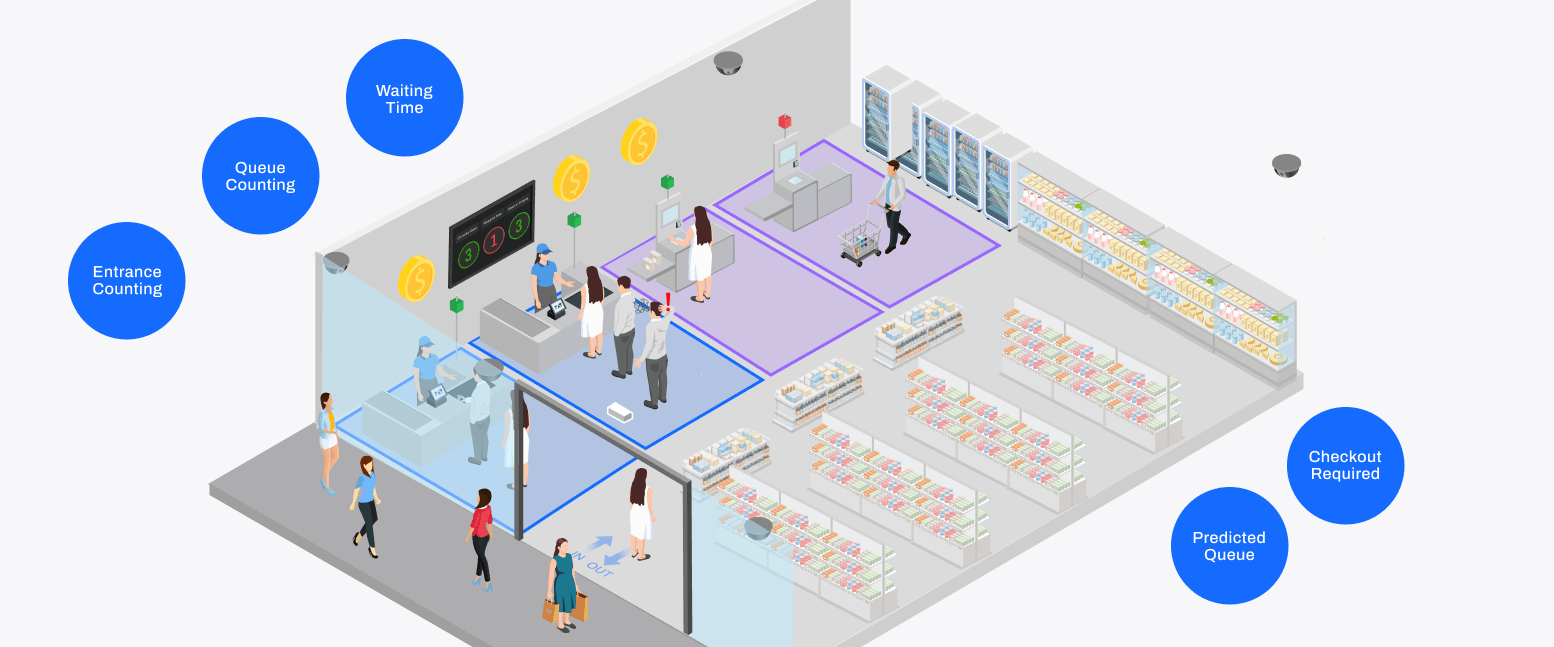
A packaged operational system combining live monitoring, demand prediction, staff actions, and performance tracking. Designed to standardise checkout execution and remove variability across stores and peak periods.
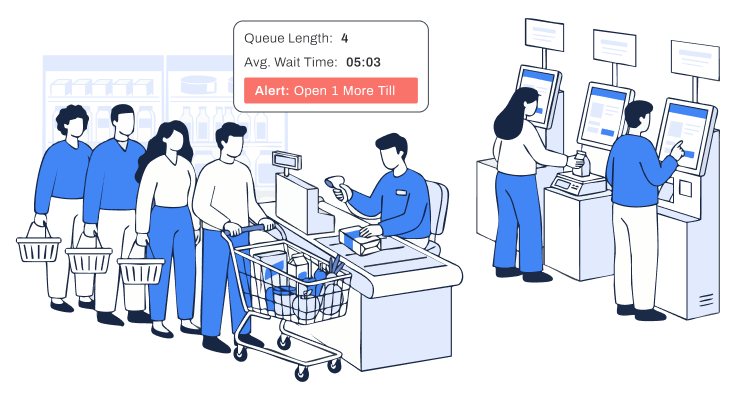
Live Queue Control
Monitor queue length, waiting time, and service rate across all checkout points, including self-checkout. Clear thresholds highlight overload conditions and trigger alerts, ensuring immediate visibility without interpretation or manual estimation.
Demand Prediction
Forecast incoming customer flow and expected queue build-up over the next 15 minutes. Calculate required checkout capacity based on real-time traffic patterns and average visit duration.
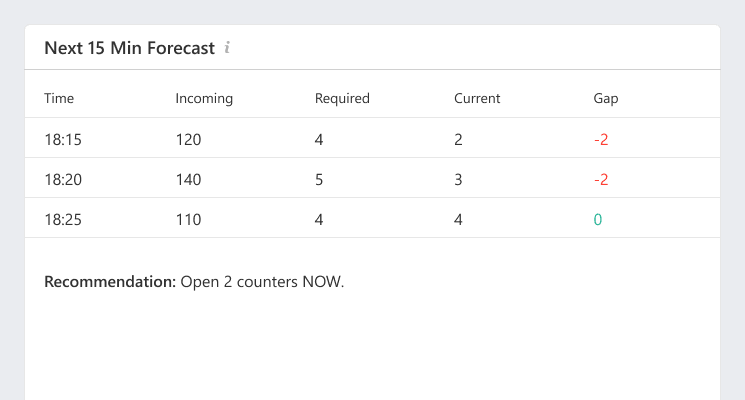
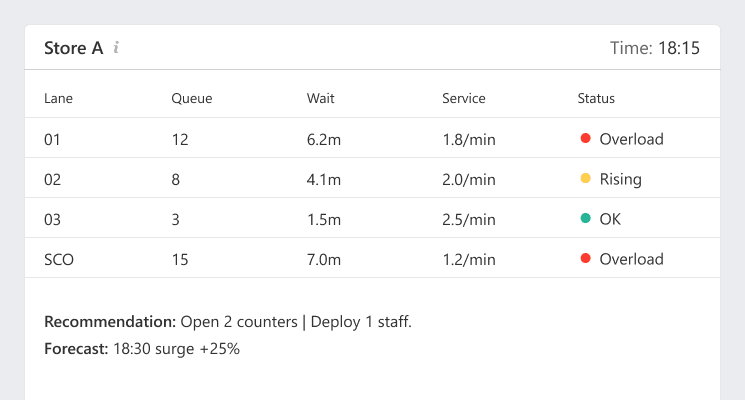
Operational Actions
Provide direct, actionable recommendations such as opening more counters, reallocating staff, or balancing load between lanes. Instructions are simple, standardised, and aligned with current store conditions to ensure consistent operational efficiency at all times.
Management Analysis
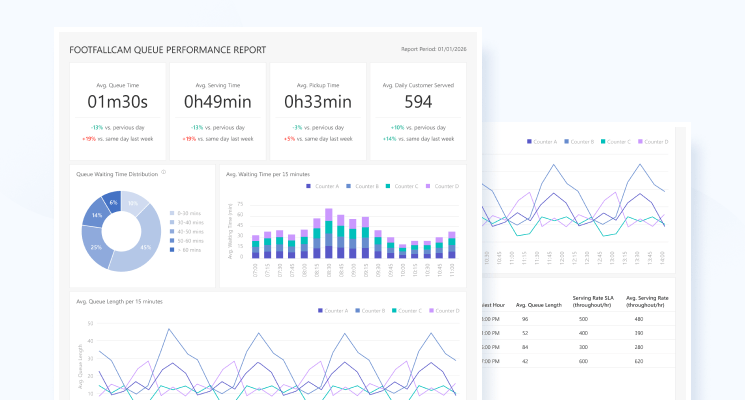
Evaluate queue conditions, service efficiency, and operational compliance to identify macro-level gaps. Analyse performance across stores and time periods, benchmark branches, quantify lost sales from waiting time, and assess staff deployment effectiveness to drive consistent service efficiency and improvement.
Operational Scenarios
Case Study
Peak hour stabilised
Self-checkout balanced
Multi-store standardised
Peak hour stabilised
Case Study 1
Peak hour stabilised
Store size
8,500 sq ft supermarket · mall-based · 6 staffed lanes + 6 self-checkout kiosks
Peak hour issue
Queues exceeded 6–8 minutes between 5:30pm–7:30pm. Counters were opened late, and staff allocation varied daily. Self-checkout congestion was frequent.
Deployment scope
Queue Control Suite deployed across all checkout points. Real-time monitoring, 15-minute prediction, and standardised action thresholds enabled.
No ongoing calibration cycles were introduced. Monitoring focused on device and data-pipeline health, not behavioural variance. After acceptance, no internal team was formed and no new operational role was created.
Measured improvement
Average waiting time reduced from 6.5 minutes to 3.2 minutes. Peak-hour queue spikes reduced by 40%. Staff response time improved, with counters opened earlier and more consistently.
Self-checkout balanced
Case Study 2
Self-checkout balanced
Store size
12,000 sq ft supermarket, stand-alone format, 8 self-checkout kiosks + 4 staffed lanes
Peak hour issue
Self-checkout queues built up rapidly during lunch and evening peaks. Staff remained at fixed positions, with no dynamic balancing between staffed and self-checkout lanes.
Deployment scope
Queue Control Suite applied to both self-checkout and staffed lanes. Load balancing recommendations introduced, with alerts for early congestion detection.
Measured improvement
Self-checkout waiting time reduced by 35%. Load distribution improved, with fewer extreme queue conditions. Staff reallocation became more responsive to real-time demand.
Multi-store standardised
Case Study 3
Multi-store standardised
Store size
Regional chain, 24 stores, average 9,000–11,000 sq ft per store
Peak hour issue
Checkout performance varied significantly across stores. No standard benchmarks or consistent response to peak demand. Reporting was limited to end-of-day summaries.
Deployment scope
Queue Control Suite deployed across all stores with standardised KPIs, thresholds, and reporting. Central dashboard introduced for regional oversight.
Measured improvement
Variation in peak waiting time reduced across stores. Underperforming locations identified and corrected. Consistent staffing response achieved during peak periods. Regional management gained visibility on execution quality.
FAQs
Learn More