





Small Retailer










Deployment & Assurance
Operational clarity for long-life airport systems
1
Deployment Responsibility & Installation
Airport deployments follow a defined sequence: survey, design, pilot, acceptance audit, and rollout.
Installation is treated as infrastructure work, not experimentation. Device counts are minimised to reduce cabling, access work, and long-term maintenance exposure. Existing physical constraints are respected; once accepted, installations are not repeatedly adjusted.

Ownership model
- Airport: physical access, power, and local approvals
- Delivery partner: installation and site works
- FootfallCam: system configuration standards and acceptance criteria
2
Accuracy Assurance & Acceptance
Accuracy is addressed once, formally, at the start of operations.
Acceptance is based on predefined audit windows, agreed metrics, and documented variance thresholds. The same method applies to any future review.
Ownership model
- Airport: physical access, power, and local approvals
- Delivery partner: installation and site works
- FootfallCam: system configuration standards and acceptance criteria

3
Operations, Monitoring & Change Control
Post-deployment operation is designed to be uneventful.
Monitoring focuses on device and data-flow health rather than passenger behaviour. Calibration is stable unless physical or operational conditions change.
Operating principles
- Exception-based monitoring
- No routine recalibration
- Logged and reversible configuration changes
4
Integration & Data Boundaries
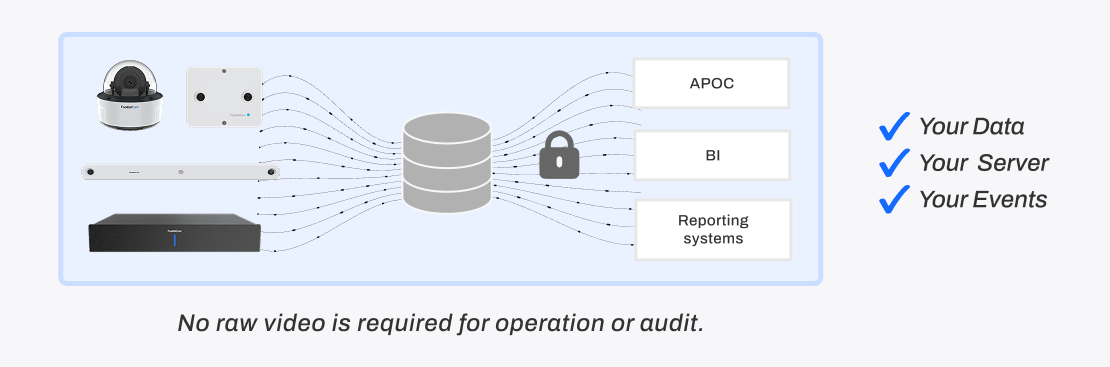
Integration is intentionally bounded.
Outputs consist of events and aggregates suitable for APOC, BI, or reporting systems. No raw video is required for operation or audit.
Integration model
- Read-only data consumption
- No embedded business logic
- Independent lifecycle from airport systems
5
Commercial & Long-Term Governance
Commercial terms are structured to remain predictable over time.
Normal airport evolution - traffic growth, seasonal change, or organisational restructuring, does not trigger renegotiation or system redesign.
Governance principles
- Fixed functional scope
- Changes tied to physical or operational modification
- Clear separation between support, enhancement, and expansion
Case Study
Some of our deployments across various airports
Medium International Airport
Large Hub Airport
Regional Airport
Capital City Airport
Multi-Terminal Airport
National Gateway Airport
Major Transit Hub
Medium International Airport
Case Study 1
Medium International Airport, Western Europe (≈18m passengers/year)
Context
The airport operates a single main terminal with mixed Schengen and non-Schengen flows. Passenger monitoring was previously handled through periodic manual surveys commissioned every two years. The airport required continuous data but had no internal analytics team and limited appetite for system ownership.
Concern Addressed
Operational ownership and long-term maintenance.
The airport operates a single main terminal with mixed Schengen and non-Schengen flows. Passenger monitoring was previously handled through periodic manual surveys commissioned every two years. The airport required continuous data but had no internal analytics team and limited appetite for system ownership.
Outcome
The deployment defined ownership boundaries at contract level. Installation was delivered by a local partner under a fixed scope. System configuration, accuracy methodology, and acceptance criteria were centrally governed. Post-acceptance, the airport’s role was limited to physical access and incident escalation.
No ongoing calibration cycles were introduced. Monitoring focused on device and data-pipeline health, not behavioural variance. After acceptance, no internal team was formed and no new operational role was created.
Principle reinforced: Clear ownership boundaries reduce organisational load.
Referenced sections: MSA – Deployment Responsibilities; Support Schedule.
Large Hub Airport
Case Study 2
Large Hub Airport, Southeast Asia (≈45m passengers/year)
Context
The airport operates multiple terminals built across different decades, each with varying ceiling heights and cabling constraints. Any new infrastructure work requires coordination with facilities, fire safety, and external contractors.
Concern Addressed
Cabling cost and installation disruption.
Previous technology projects had failed due to underestimated civil works and repeated ceiling access.
Outcome
The deployment prioritised coverage efficiency over device density. Camera counts were minimised through overhead placement and wider zones. Installation was treated as one-time infrastructure work, coordinated alongside existing maintenance windows.
Once installed and accepted, no repositioning was permitted unless triggered by a structural change. This avoided repeat access approvals and follow-up cabling work.
Principle reinforced: Install once, accept once, and avoid iterative change.
Referenced sections: SOW – Installation Scope; Change Control Clause.
Regional Airport
Case Study 3
Regional Airport, Northern Europe (≈6m passengers/year)
Context
The airport operates multiple terminals built across different decades, each with varying ceiling heights and cabling constraints. Any new infrastructure work requires coordination with facilities, fire safety, and external contractors.
Concern Addressed
Cabling cost and installation disruption.
Previous technology projects had failed due to underestimated civil works and repeated ceiling access.
Outcome
The deployment prioritised coverage efficiency over device density. Camera counts were minimised through overhead placement and wider zones. Installation was treated as one-time infrastructure work, coordinated alongside existing maintenance windows.
Once installed and accepted, no repositioning was permitted unless triggered by a structural change. This avoided repeat access approvals and follow-up cabling work.
Principle reinforced: Install once, accept once, and avoid iterative change.
Referenced sections: SOW – Installation Scope; Change Control Clause.
Capital City Airport
Case Study 4
Capital City Airport, Middle East (≈28m passengers/year)
Context
The airport operates under strict privacy governance. Any system involving video or personal data requires extensive legal review and executive sign-off.
Concern Addressed
Legal and privacy exposure.
The legal team sought to avoid expanding data protection scope.
Outcome
The system was deployed without raw video retention. Acceptance audits relied on controlled observation periods rather than stored footage. Legal review focused on data outputs only.
This significantly reduced DPIA scope and ongoing compliance obligations.
Principle reinforced: Eliminating video eliminates legal overhead.
Referenced sections: MSA – Data Use & Retention; Privacy Schedule.
Multi-Terminal Airport
Case Study 5
Multi-Terminal Airport, Australia (≈32m passengers/year)
Context
The airport planned a phased rollout aligned to annual capital budgets. Full deployment was not approved upfront.
Concern Addressed
Commercial predictability across years.
Outcome
Each phase reused the same deployment template and acceptance method. Pricing and scope were fixed per phase, avoiding renegotiation. Earlier phases did not require redesign when later phases were approved.
Principle reinforced: Standardisation enables phased commitment.
Referenced sections: Commercial Terms; Term & Renewal Clause.
National Gateway Airport
Case Study 6
National Gateway Airport, South America (≈22m passengers/year)
Context
The airport had experienced a leadership change mid-project, resulting in renewed scrutiny of all vendor contracts and system performance.
Concern Addressed
Executive re-review after acceptance.
Outcome
A formal acceptance record, including audit methodology and signed thresholds, was presented. A re-audit followed the same predefined method, producing comparable results.
No reinterpretation of metrics was required. The system remained accepted without renegotiation.
Principle reinforced: Documented acceptance prevents retrospective disputes.
Referenced sections: MSA – Acceptance & Audit Schedule.
Major Transit Hub
Case Study 7
Major Transit Hub, East Asia (≈50m passengers/year)
Context
The airport APOC required congestion and dwell indicators but did not want operational responsibility for underlying systems.
Concern Addressed
Operational accountability creep.
Outcome
APOC consumed read-only indicators. No configuration access or tuning authority was granted. Responsibility for system behaviour remained clearly external.
Principle reinforced: Consumption without ownership.
Referenced sections: Data Boundary Clause; APOC Interface Schedule.